My 2025 with Cursor: From Tab to Agent
A year in numbers
Cursor sent me my 2025 wrapped, and it told a story I hadn't quite noticed while living it. I started the year still typing — leaning on autocomplete, finishing my own thoughts, very much in the driver's seat. I ended it letting the Agent do most of the work.
You can read the whole arc in two numbers: 8,532 Tab presses and 616 agent messages. One of those is the engineer I was in spring. The other is the one I'd become by autumn.
So here's my year with Cursor, told the way it actually happened — from Tab to Agent.
The Tab year
Let me start with my favorite stat, because it's the one I'm a little nostalgic about.
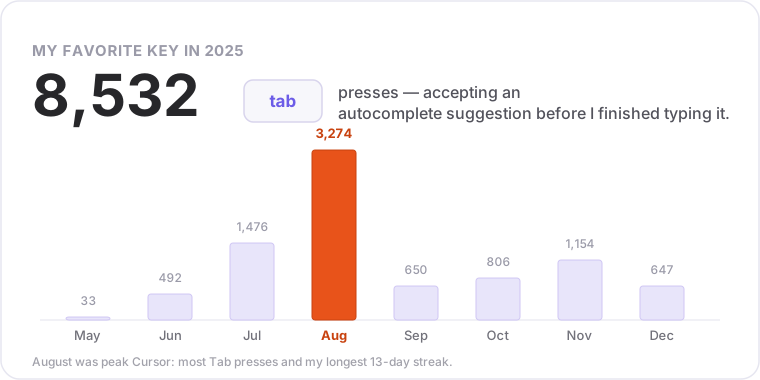
8,532 presses. Tab was, by a wide margin, the key I leaned on most. And I loved it — not for any deep reason, but for pure speed and flow. Cursor's autocomplete kept me in the zone: it finished the line before I did, I'd glance, hit Tab, and keep moving. No context switch, no waiting on a chat, no reading a diff. Just me, typing, with the friction sanded off.
Yes — at that point I was still coding a fair bit myself. Tab wasn't the machine doing the thinking; it was the machine getting out of my way while I did. That distinction mattered to me then, and honestly it still does.
The shape of the chart is the tell. A trickle in May, building through summer, and then August — 3,274 presses in a single month, my most intense stretch of the whole year. That was peak Cursor: the most Tab presses, and my longest streak too. After that, the line comes down and never climbs back. Something was shifting.
Enter the Agent
What was shifting, of course, was that I'd stopped typing as much and started delegating.
Across the year I sent 616 messages to the Agent over 151 chats, and the curve peaks right alongside the Tab one — July and August were the months I put the Agent to work hardest. I used Cursor on 145 days, with a longest streak of 13 days, and — no surprise — that streak landed in August.
That's the quiet plot twist of the whole recap. The two peaks sit back to back: I was tab-completing furiously and leaning on the Agent in the same stretch. August was the month the old way and the new way overlapped — the last big hurrah of me-as-typist, and the first real surge of me-as-orchestrator. Everything after it tapers, because by autumn the Agent was simply doing more of the work than my keyboard was.
A year of models
The other thing that drifted over the year was which model I was talking to.
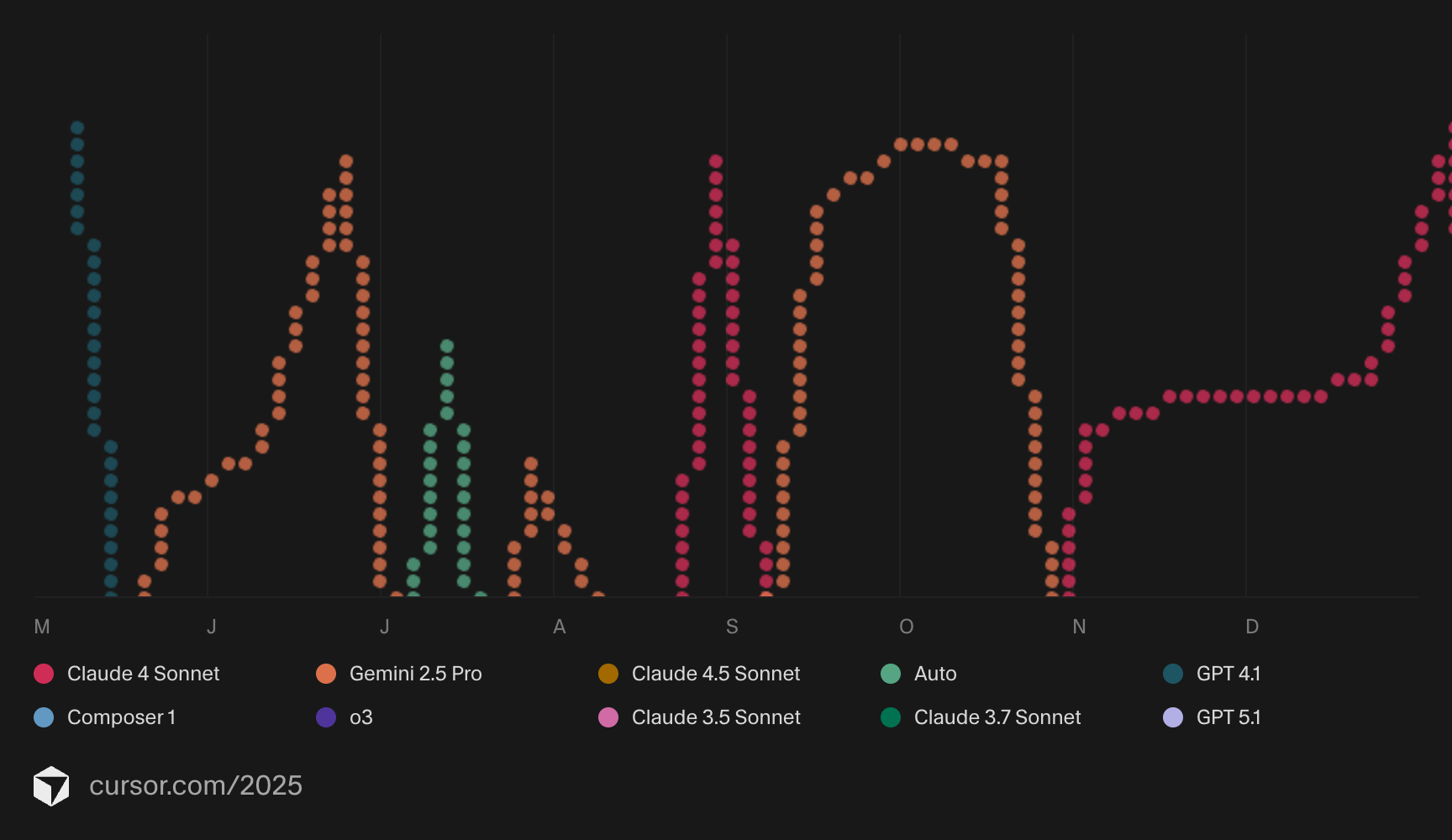
I opened the year on GPT 4.1, but the bulk of the chart belongs to Gemini 2.5 Pro — it carried me through the heavy-building summer. I won't pretend it was a rigorous decision: a friend of mine, a director of design who'd caught the vibe-coding bug himself, told me to just try Gemini. I did, it was fast and a great default for the kind of work I was doing, and it stuck for months.
By the back half of the year the needle had swung to Claude 4 Sonnet and then 4.5 Sonnet — better feel for the tougher work, and my top three for the year ended up Gemini 2.5 Pro, Claude 4 Sonnet, Claude 4.5 Sonnet, in that order. (There were cameos too — o3, Composer 1, Auto, a bit of GPT 5.1.) It mirrors something I keep coming back to: there's no one best model, just the right one for the task in front of you.
The recap card
Here's the whole year on a single card, if you want the numbers at a glance:
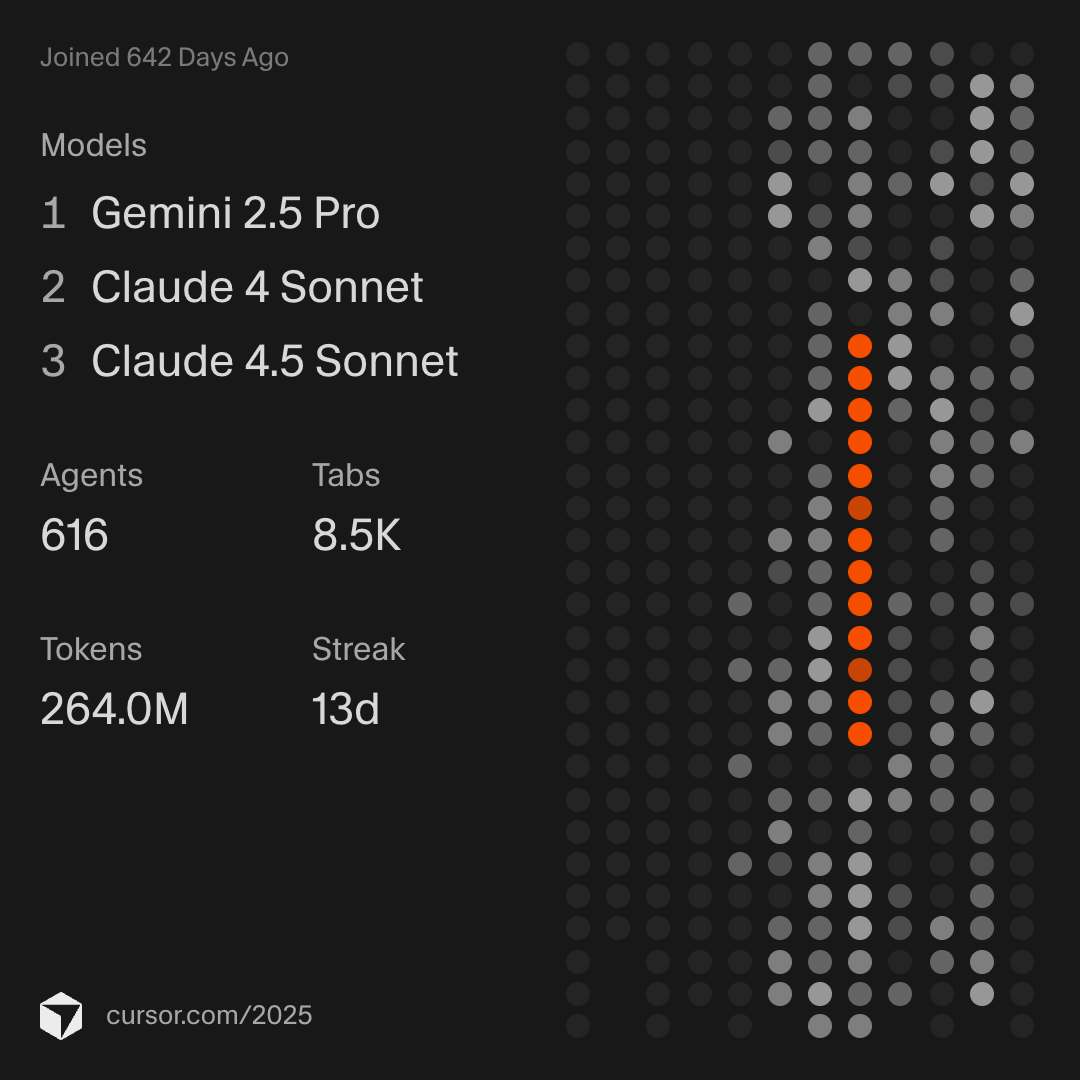
264.0 million tokens over the year. That's a lot of coins fed into the machine — and a decent chunk of my evolution as an engineer captured in one square image. If you're curious, my profile is public: cursor.com/@vinod.
Which brings me to the part the chart only hints at.
Giving Claude Code a chance
If you look at that recap and then at my profile today, you'll notice the line went quiet over the last few months. That's not Cursor's fault — it's me. I gave Claude Code a chance, and I haven't really gone back.
It wasn't a dramatic breakup. Cursor was my gateway into AI coding, and I still respect what it does. But the ground kept moving: the skills ecosystem kept growing, my X feed wouldn't stop talking about it, friends kept bringing it up, and a steady diet of Matt Pocock's content nudged me the rest of the way. At some point it just felt like something I had to try — agent-first, terminal-native, skills everywhere.
So I tried it. And the way that experiment reshaped how I think about coding with AI — the fatigue, the discipline, the foundations you can't skip — turned into a whole post of its own: State of Coding, June 2026.
But that's the next chapter. This one ends in August 2025, with me hammering Tab 3,274 times and not yet knowing it was the high-water mark of typing my own code.